Perfect B, Doral Fl. | 09.30.25 | 5 min read.
A quick story about hype, hope… and what really works
In the world of medical aesthetics, our patients often ask about viral trends, and few have generated as much buzz as mewing. We hear the questions constantly: “Have you seen the jawlines people get online?” and, most importantly, “does mewing actually work?” As doctors specializing in facial aesthetics, our job is to provide clear, evidence-based answers. Before you invest time in this technique, it’s crucial we first define mewing from a medical standpoint, analyze the instructions on how to mew, and discuss the real risks of a DIY mewing jawline exercise compared to professional treatments. This guide will thoroughly examine the claims and explain why a mewing device is no substitute for medical science.
What is Mewing? Defining the Social Media Trend
Let’s start with the fundamental task: to define mewing. The simplest mewing definition is the conscious practice of resting your entire tongue flat against the roof of your mouth. The ultimate goal is to define mewing not just as a temporary action, but as a permanent postural habit. This concept was popularized by Dr. Mike Mew, whose followers believe this pressure can reshape the facial skeleton. The core question many people have is what does mewing do? Proponents claim it leads to a stronger jawline and higher cheekbones, but it’s vital we continue to define mewing based on medical reality, not online anecdotes.
The Technique: How to “Mew Correctly”
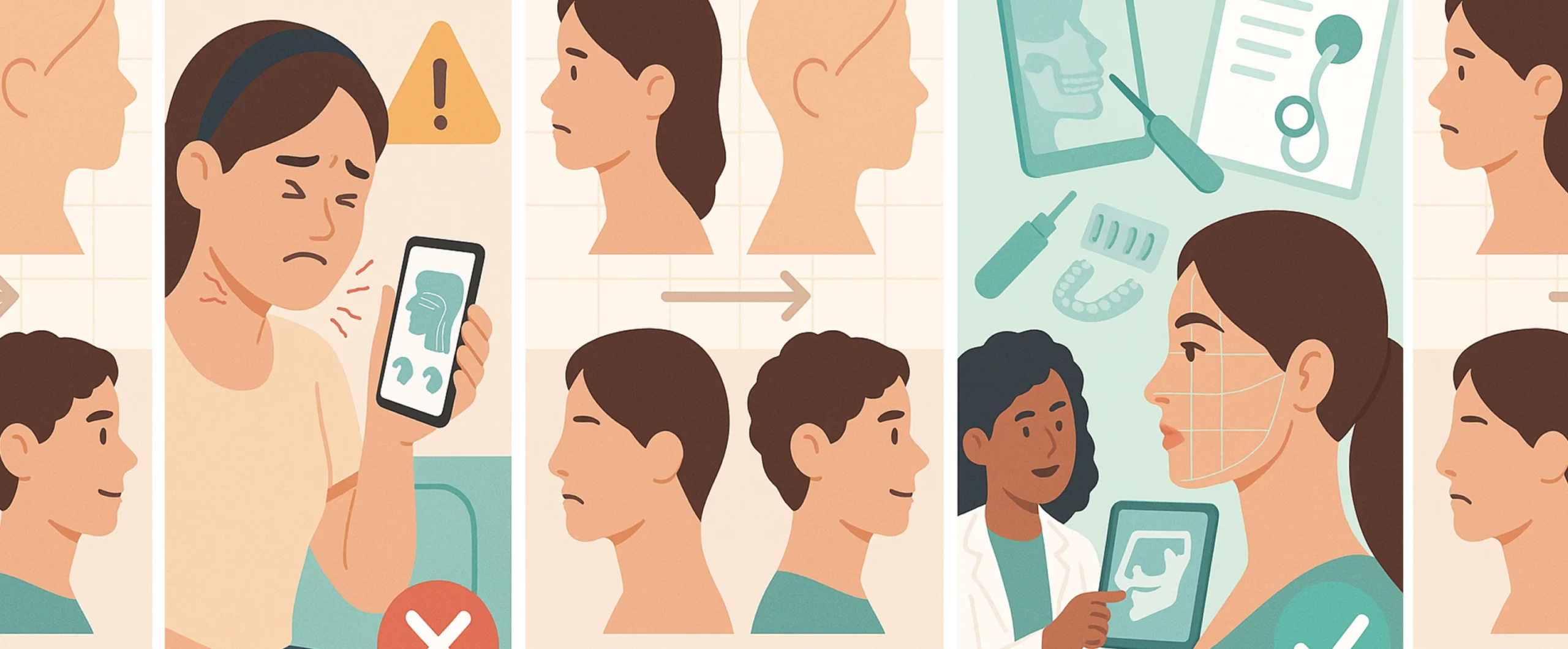
To properly critique the trend, we must first understand the method. A standard mewing tutorial will provide detailed instructions on how to mew. For those wondering how to properly mew, the technique is quite specific. Learning how to mew involves sealing your lips, keeping your teeth lightly touching, and pressing your entire tongue against the palate. Many online guides that show you how to mew suggest making an “ng” sound to feel the back of the tongue engage. Mastering the instructions on how to mew correctly is considered essential by followers for the technique to have any effect.
The Reality Check: Does It Actually Work?
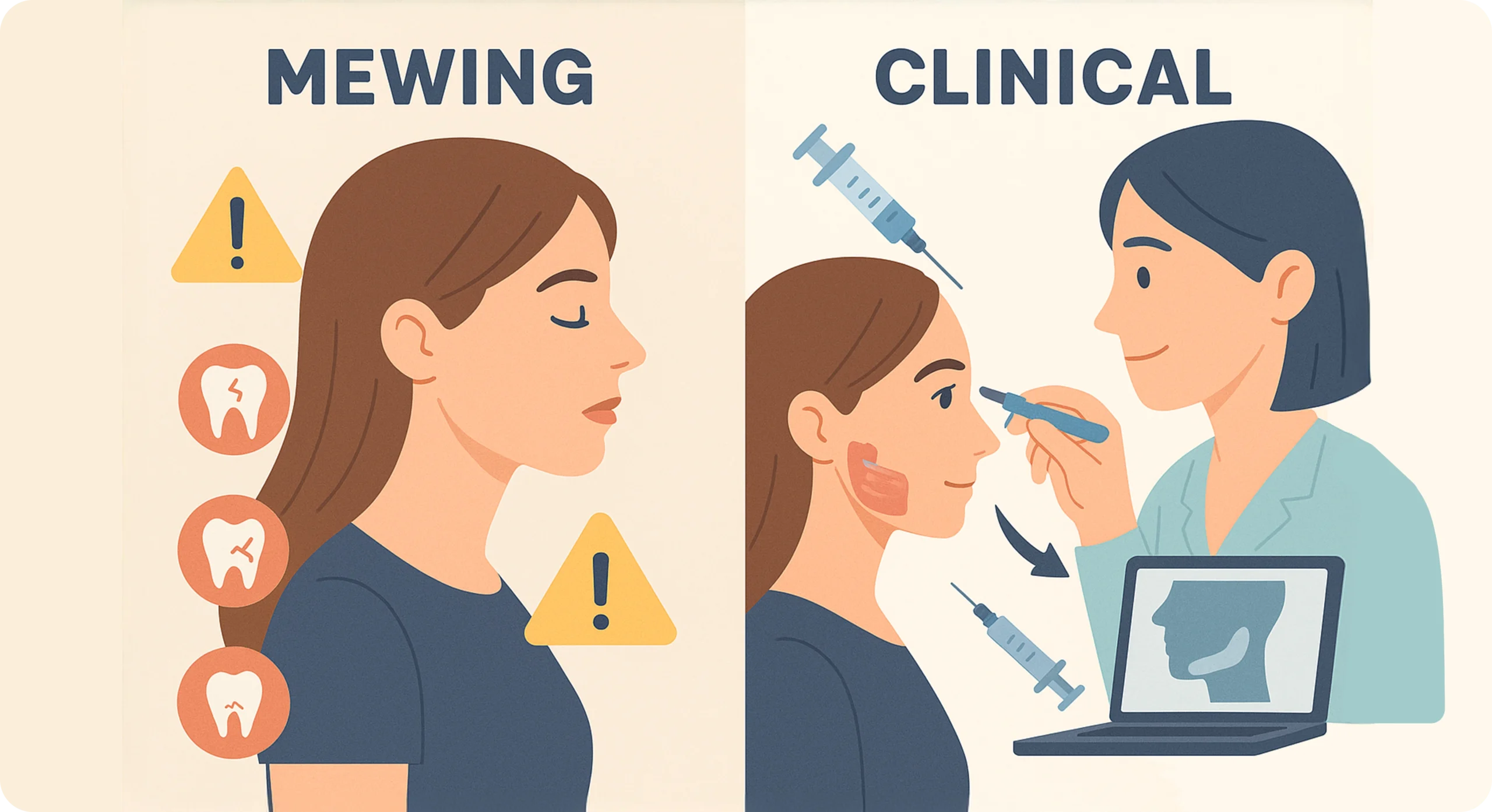
This brings us to the most important question: does mewing actually work? From the perspective of aesthetic medicine, the answer is an unequivocal no. For an adult with a fully formed facial structure, it is anatomically impossible for tongue pressure to cause the significant changes promised. So, when patients ask us, “does mewing actually work?”, our answer is always consistent and based on science. The dramatic mewing result and mewing face transformations online are often due to lighting, weight loss, or camera angles.
(…) Different professional bodies, such as the American Association of Orthodontists, have publicly stated that there is no scientific research to support the claim that does mewing actually work to alter facial structure.
The question of “is mewing real?” is complex; the practice is real, but the aesthetic results are not. Instead of asking does mewing actually work, the better question is, “what truly works for facial enhancement?”
The Perfect B Approach: From DIY Frustration to Professional Results
This is where we must define mewing in contrast to medically accepted jawline enhancement methods. Mewing has gained attention on social media as a do-it-yourself way to “sculpt” the jawline by adjusting tongue posture. While it’s often presented as a natural alternative to cosmetic procedures, it isn’t recognized as a medical treatment. In contrast, clinically accepted jawline enhancement methods like dermal fillers, Botox for masseter reduction, or surgical contouring are grounded in anatomy, measurable outcomes, and safety protocols. The truth is, mewing tends to rely on self-guided practice without clinical oversight, which makes its results unpredictable.
At Perfect B, we see patients curious about mewing but unsure if it truly works. Many arrive after months of trying it, frustrated that they haven’t noticed real changes. Sometimes, they even report jaw tension, bite issues, or discomfort from forcing posture habits. That’s where we take a different approach. Instead of relying on “one-size-fits-all” techniques, we personalize treatments, balancing the face by considering bone structure, muscle activity, and skin quality. For example, a patient with a soft jawline might benefit from fillers to create definition, while another with overdeveloped jaw muscles might respond better to Botox.
We educate our patients about when it’s time to move from self-directed methods like mewing to medical options, usually when they want visible, reliable, and safe results. Long-term, clinical facial contouring has been shown to deliver predictable outcomes that mewing simply cannot match. While posture awareness can support good oral and facial health, true structural enhancement requires professional intervention. At Perfect B, our focus is always on safe, lasting, and natural-looking balance something mewing alone has yet to achieve.
The Risks of DIY Mewing Exercises and Devices
As noted by our patients, the frustration with a lack of results is often compounded by physical discomfort. A rigorous mewing jawline exercise can be actively harmful. The primary danger comes from unregulated mewing tools and the improper application of force. A commercial mewing device is not a medical instrument; it’s a product sold without professional oversight. Any self-guided mewing jawline exercise can create bite problems and TMJ pain. The danger of using an aggressive mewing device is that it can over-activate the masseter muscles. Any advertised mewing device is a risk, and we advise patients that no mewing device is a safe alternative to professional care.
(…) Medical experts outside of aesthetics frequently warn about the dangers of self-directed jaw exercises. The American Dental Association, for example, notes that improper pressure and jaw positioning can lead to temporomandibular joint (TMJ) disorders, causing pain and dysfunction.
An intense mewing jawline exercise can backfire. A simple mewing jawline exercise seems harmless, but it can have consequences.
Clinically Proven Methods for Jawline Enhancement
While a mewing jawline exercise is futile, medical aesthetics offers a suite of proven treatments to sculpt the jaw. Our professional procedures are far more sophisticated and effective than any mewing device.
- Dermal Fillers: We use fillers to add structure directly to the mewing jaw, creating definition that a mewing jawline exercise can only dream of.
- Neurotoxins (Botox®): These relax the muscles that pull the jawline down, creating a lift and slimming the face.
- Collagen-Stimulating Treatments: Energy-based devices tighten the skin, addressing the laxity that no amount of tongue pressure can fix.
➔ Explore our jawline filler treatments to see how we achieve dramatic yet natural-looking results.
Decision Flow: Is Tape “Okay for Tonight,” or Is It Time for a Consult?
Big event, zero downtime? A single, short application may be acceptable if your skin tolerates adhesives. Choose a skin-safe option (what tape to use for face taping), keep wear minimal, and remove slowly with oil. If you’re shopping best face tapes for wrinkles, prioritize medical-grade silicone and read return policies.
Bothered daily or breaking out? Skip night face tape for wrinkles and face taping at night. Book a consult so we can match the concern (dynamic lines vs. static folds vs. texture) to the correct treatment sequence.
For those who still prefer silicone tape for wrinkles, limit wear time and avoid fragile zones like the upper eyelid and thin under-eye.
Not sure what tape to use for face taping for a one-time event? We outline what tape to use for face taping and safer alternatives during your consult.
FAQ: Mewing Myths vs. Medical Facts
Q1 How do we define mewing in contrast to medically accepted jawline-enhancement methods?
Mewing is a self-directed technique that promotes a specific tongue posture (roof of the mouth), lip seal, and head position with the goal of subtly changing facial appearance over time. In contrast, medically accepted methods (think orthodontics, orthognathic surgery, dermal fillers, and soft-tissue procedures) are performed (or prescribed) by trained clinicians, use diagnostic imaging and measurements, and have predictable, measurable outcomes. In short: mewing is a posture habit; clinical treatments are targeted interventions based on anatomy and science.
Q2 Can we define mewing as a legitimate practice backed by medical evidence?
The honest answer: not yet. There are plausible biomechanical ideas, posture affects muscles and soft tissues but high-quality clinical trials showing consistent, meaningful facial bone changes in adults are lacking. For growing adolescents, orthodontic guidance can influence facial development; for adults, the evidence that simple tongue posture alone reshapes bone is very weak.
Q3 What are the risks associated with advising patients on how to mew without medical oversight?
Risks are mostly indirect but real: improper guidance can worsen jaw pain, provoke or amplify TMJ symptoms, change bite alignment, or encourage unsafe devices or exercises. In addition, patients may delay effective treatment (like orthodontics or orthognathic consultation) while chasing uncertain results. So,like many trends it’s low risk in theory but can produce harm if done without assessment.
Q4 Can mewing face changes be substantiated through scientific facial analysis?
Small soft-tissue and posture improvements (better head carriage, firmer platysma, subtle cheek lift from improved muscle tone) can be documented with photos, 3D surface scans, or facial analysis but controlled studies showing consistent, clinically meaningful bone changes in adults are missing. In plain terms: we can measure some differences, but linking them directly and reliably to mewing alone is not proven.
Q5 Are mewing devices medically safe or just another trend with no clinical value?
Most commercially marketed “mewing” devices lack rigorous safety and efficacy testing. Some are harmless, but others may force unnatural bite positions, irritate tissues, or amplify TMJ problems. Until a device is evaluated in proper clinical trials and cleared by dental/medical regulators, treat them skeptically, they’re usually trend products, not medical devices.
Q6 From a clinical standpoint, does mewing actually work on bone structure or muscle?
Clinically, mewing is unlikely to remodel adult facial bone in any predictable way. What it can do is influence muscle tone, tongue posture, and head position and those soft-tissue and postural shifts can make a face look a bit different. If bone change is the goal, the reliable routes are orthodontics or surgery; if posture and muscle tone are the goal, then targeted exercises under a clinician’s guidance may help.
Q7 Can mewing exercise routines realistically compete with aesthetic treatments like fillers?
No, not really. Fillers give immediate, controlled volume and contour changes with predictable results; mewing works slowly, if at all, and primarily affects posture and soft tissue tone. Think of it this way: fillers are a sculptor’s tool, precise and fast; mewing is like a long-term workout plan, subtle, variable, and dependent on many factors. That said, combining sensible posture work with professional aesthetic care can be complementary, not mutually exclusive.
Conclusion: For Real Results, Trust Medical Science
We took the time to define mewing and answer the critical question: does mewing actually work? The clear answer is no. The practice, along with any mewing device or exercise, is not a substitute for medical treatment. Instead of practicing mew mewing in the mirror and wondering how to mew correctly, we invite you to explore real, science-backed solutions.
➔ See if our advanced facial balancing and jaw contouring treatments are right for you.