
Perfect B, Doral Fl. | 10.20.25 | 5 min read.
The trend of facial exercises has surged in popularity, promoted as a natural, non-invasive method for achieving a more youthful look. Countless online tutorials promise that with the right routine, you can achieve everything from a defined jawline to lifted cheekbones. Patients often come to our Doral, FL clinic asking about the effectiveness of specific routines, from facial exercises for jowls to targeted facial exercises for cheeks. However, it is our professional responsibility to look beyond the hype. This guide will provide a clinical look at these facial exercises, examine the claims versus the evidence, and explain why we advocate for proven, evidence-based treatments.
The Claims vs. The Science: A Foundation of Limited Evidence
Facial yoga and similar routines are frequently marketed as a “natural facelift.” The core claim is that by performing targeted facial workouts, one can tone muscles to lift sagging skin and re-contour the face. While this sounds appealing, the scientific evidence backing these claims is remarkably thin.
The most frequently cited support comes from a single 2018 study from Northwestern University. This study suggested that a 20-week program of facial exercises led to participants looking slightly younger. However, in the medical community, a single study with a small sample size, no control group, and subjective evaluations is not considered robust evidence. It certainly isn’t enough to validate the widespread and specific claims about routines like facial exercises for cheeks magically creating lifted cheekbones or eliminating the need for clinical intervention. The simple truth is, there are no large-scale, peer-reviewed clinical trials that prove the efficacy of these facial exercises for significant rejuvenation.
The Clinical Reality: Why Facial Exercises Can Be Counterproductive
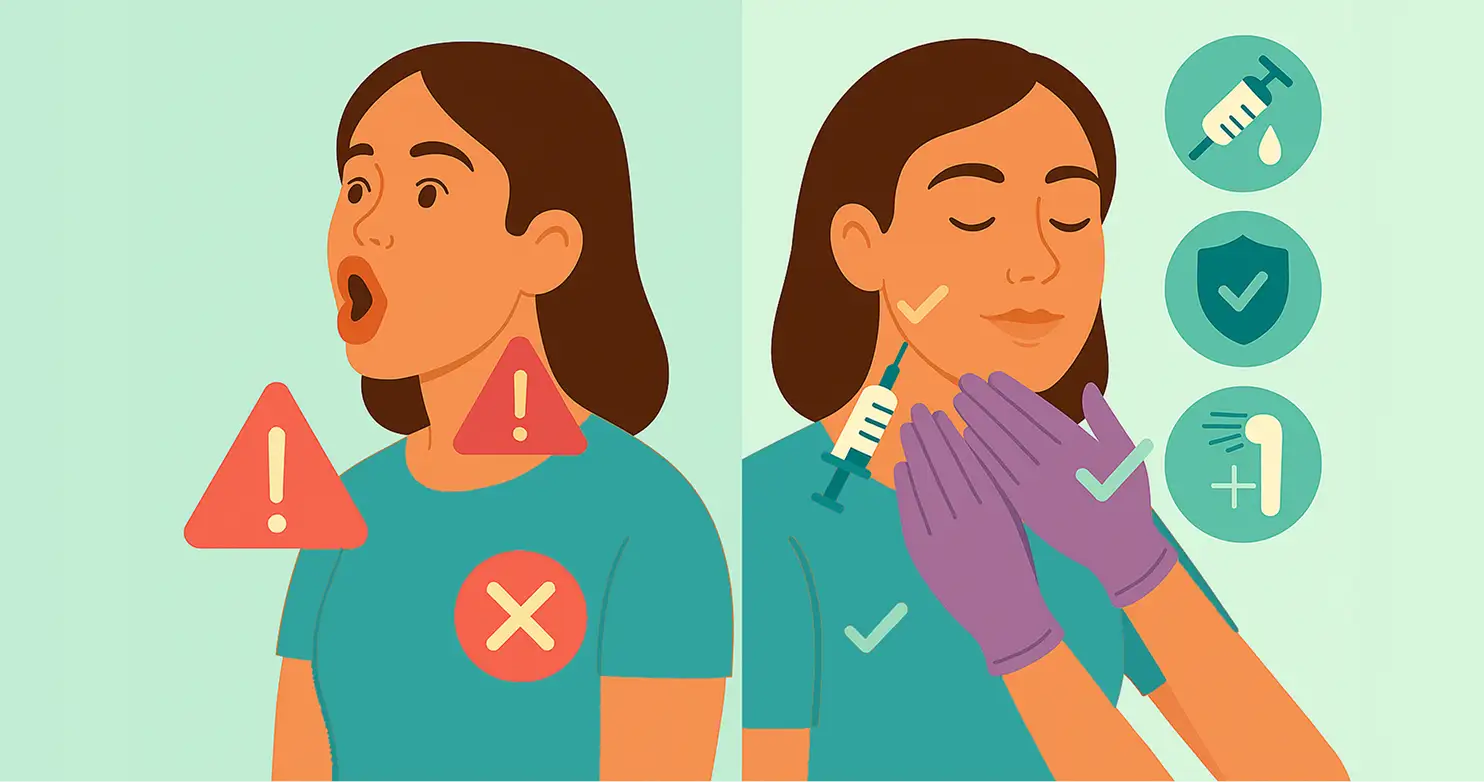
From a clinical perspective, there’s no strong evidence showing that facial exercises can deliver lasting, meaningful results. In fact, many of the repetitive, exaggerated movements they require can be counterproductive. We know that dynamic wrinkles, like crow’s feet and laugh lines, are caused by repeated muscle contractions. Therefore, a routine based on intense face exercises smile lines could inadvertently etch those very lines deeper into the skin over time. The goal should be to soften lines, not reinforce the movements that cause them.
Furthermore, aggressive facial exercises for jowls can create tension in the jaw (TMJ) without addressing the root causes of jowling. Facial aging is a complex, multi-layered process. It involves the thinning of the skin, the loss and descent of facial fat pads, and even bone resorption. Simply ‘working out’ the muscles beneath these layers does little to address these primary structural changes; a toned muscle under lax skin will not create a genuine lift. Similarly, vigorous facial exercises for cheeks can be problematic, especially for patients with dermal fillers, as the movements could potentially disrupt or shorten the lifespan of the filler. The promise of achieving naturally lifted cheekbones through these methods is misleading, as exercises cannot restore lost facial volume.
(…) According to the JAMA Dermatology study, “The exercises enlarge and strengthen the facial muscles, so the face becomes firmer and more toned and shaped like a younger face.” This finding gives a scientific foundation to the practice.
In the study, participants who followed a 20-week program were perceived to look nearly three years younger. However, it is crucial to interpret these findings with a clinical perspective, as this single study has notable limitations.
Expert Consensus and External Resources
Our clinical viewpoint aligns with the broader consensus among dermatologists and plastic surgeons. When evaluating any aesthetic trend, it’s crucial to consider the opinions of major health and medical authorities.
(…) For additional reading, the Harvard Medical School publication, Harvard Health Publishing, offers an article titled “Does your face need a workout?” which discusses their limitations and cautions that repeated, forceful movements can actually worsen the lines people are trying to eliminate.
This expert consensus underscores the importance of choosing treatments backed by robust scientific validation rather than social media popularity.
The Perfect B Protocol: Why Evidence-Based Treatments Are Core
At Perfect B, we do not offer or endorse facial yoga as a treatment because it does not meet our high standards for safety and effectiveness. Our protocol is to educate patients honestly. When someone asks if a set of facial exercises for jowls will work, we explain the clinical reasoning why it won’t deliver the desired results. Instead of promoting ineffective face exercises smile lines, we guide our patients toward proven, evidence-based options.
Treatments like biostimulators, collagen-boosting energy devices, and expertly administered dermal fillers are designed to address the physiological causes of aging—collagen loss, skin laxity, and fat pad descent. A set of facial exercises for cheeks cannot rebuild your body’s collagen framework or restore lost volume. For patients aspiring to achieve lifted cheekbones or a defined jawline, tailored facial balancing offers predictable, safe, and beautiful results. Our protocol prioritizes treatments that are backed by science because our commitment is to our patients’ results and safety.
Examples of Common Facial Exercises (For Educational Purposes)

While we do not endorse these movements as effective treatments, we believe in educating our patients so they can recognize what is being promoted online. Here are a few examples:
- The Cheek Lifter: This popular movement, often featured in guides for facial exercises for cheeks, involves making an “O” shape with the mouth and smiling to repeatedly lift the cheek muscles. The claim is that this builds volume, but it cannot create the substantive change required for truly lifted cheekbones.
- The Jawline Sculptor: This is a cornerstone of most online facial exercises for jowls routines. It involves pushing the lower jaw out to create tension. Unfortunately, this does little to address the skin laxity that actually causes jowls.
- The ‘O’ Pose: As a primary movement for face exercises smile lines, this involves making a tight “O” and smiling against the tension. Again, this repeatedly creases the skin in the exact areas patients want to soften, making it a questionable practice. This is not the way to perform effective face exercises smile lines.
FAQ: Mewing Myths vs. Medical Facts
Q1 Facial exercises: do they actually lift or just tone?
Facial exercises mostly help with tone, not with a true “lift.” Think of it like going to the gym, your muscles may feel firmer and more active, but that doesn’t mean gravity stops working on your skin. What people often notice is a slight tightening or definition, but it’s not the same as what medical treatments can achieve when it comes to lifting.
Q2 Facial exercises: what evidence is there from a clinical or medical perspective?
From a clinical standpoint, research is pretty limited. A few small studies suggest that certain routines might improve facial fullness or give a healthier appearance. However, there’s no strong medical evidence proving facial yoga can replace aesthetic treatments like fillers, threads, or energy-based skin tightening. In other words, it can be a nice add-on, but not a replacement for clinical methods.
Q3 Facial exercises: what risks (wrinkles, volume loss) should be considered?
Here’s the tricky part: repetitive movements like exaggerated smiling, puckering, or scrunching can actually deepen expression lines over time. Just like how frowning leads to forehead wrinkles, overdoing facial exercises can accelerate those creases. Also, for people with already thin or aging skin, constant pulling and stretching might make laxity or volume loss more visible instead of less.
Q4 Lifted cheekbones: can training create visible contour?
Training can make cheek muscles a bit firmer, which may give the illusion of more . But it won’t truly “lift” the cheekbones themselves. Think of it as a soft glow-up from toning not a sculpting procedure that changes estructuré.
Q5 Does muscle hypertrophy from face exercises for cheekbones create visible lift?
Facial muscles don’t grow the same way biceps do. Yes, some hypertrophy (muscle growth) can occur, but it’s usually subtle. A little plumpness may add shape to the midface, but it won’t create that sharp, lifted cheekbone look most people are aiming for.
Q6 Do facial lifting exercises counter true skin laxity or mainly tone?
They mainly tone. Skin laxity comes from collagen loss, gravity, and reduced elasticity, all things facial exercises can’t fully fix. For real lifting, treatments like biostimulators, energy-based tightening (RF), or threads are far more effective. Exercises may support overall muscle health, but they don’t stop sagging skin.
Conclusion
While the notion of a “natural facelift” through facial exercises is an appealing one, it is a concept unsupported by strong clinical evidence. The pursuit of lifted cheekbones or a lasting solution to sagging through routines like facial exercises for cheeks and facial exercises for jowls often leads to frustration and negligible results. As a medical aesthetics practice, our commitment is to patient safety and predictable outcomes. For meaningful and lasting rejuvenation that addresses the true causes of aging, turning to proven, evidence-based treatments is the most effective and reliable path forward.