
Perfect B, Doral Fl. | 10.09.25 | 5 min read.
What is facial yoga and how it differs from other facial workouts
The trend of facial exercises has surged in popularity, promoted as a natural, non-invasive method for achieving a more youthful look. Countless online tutorials promise that with the right routine, you can achieve everything from a defined jawline to lifted cheekbones. Our clinic in Doral FL offers honest guidance on this topic of facial exercises to help you understand what is realistic and what is not. It is our professional responsibility to look beyond the hype. This guide will provide a clinical look at these facial exercises, examine the claims versus the evidence, and explain why we advocate for proven, evidence-based treatments.
How facial exercises may work, without the hype
Small studies and clinical experience suggest three plausible mechanisms.
- Muscle tone and support. Targeted contraction may increase muscle endurance and thickness in some areas. This is why people look for face firming exercises facial lifting exercises or tightening face exercises.
- Circulation and lymph flow. Gentle movement and self massage can improve comfort and reduce morning puffiness.
- Tension retraining. Many of us habitually overuse forehead and periocular muscles. Learning soft eyes and controlled smiles can help.
The mechanisms above are plausible. However rigorous proof remains limited and outcomes vary with consistency and technique.
Do they work, a concise look at evidence

The best known study is a Northwestern led pilot published in JAMA Dermatology in 2018. Participants learned a thirty two move program. They practiced thirty minutes daily for eight weeks. They then shifted to every other day until twenty weeks. Blinded dermatologists rated photos. Upper and lower cheek fullness improved and estimated age dropped modestly by about two to three years at twenty weeks. Limitations included a small sample middle aged women only no control group and several dropouts.
This is why face exercises before after galleries can be misleading. Results require months of consistency and are typically subtle rather than dramatic. Consumer health editors also emphasize precautions and realistic timelines.
(…) Review peer reviewed discussion of facial exercise outcomes and time investment in JAMA Dermatology and a patient friendly overview on WebMD. These resources explain why evidence is limited and why timelines are long.
Bottom line. Treat facial yoga as a low risk adjunct for comfort and awareness. Do not expect it to replace targeted in clinic options. This review centers on facial exercises in a clinical context so that readers understand where facial exercises fit and how facial exercises can complement professional care.
Our clinical perspective and protocol
Facial Yoga and Facial Exercises: What are they and do they have effectiveness in Aesthetics? Facial yoga and facial exercises are often promoted as natural face lifts. The idea is simple, by moving, stretching, or training facial muscles, promoters claim you can lift sagging skin, contour cheekbones, and even smooth out wrinkles. It sounds appealing, almost like taking your face to the gym but the truth is more nuanced. While some people may notice a sense of firmness or improved circulation, the science behind these promises is very limited.
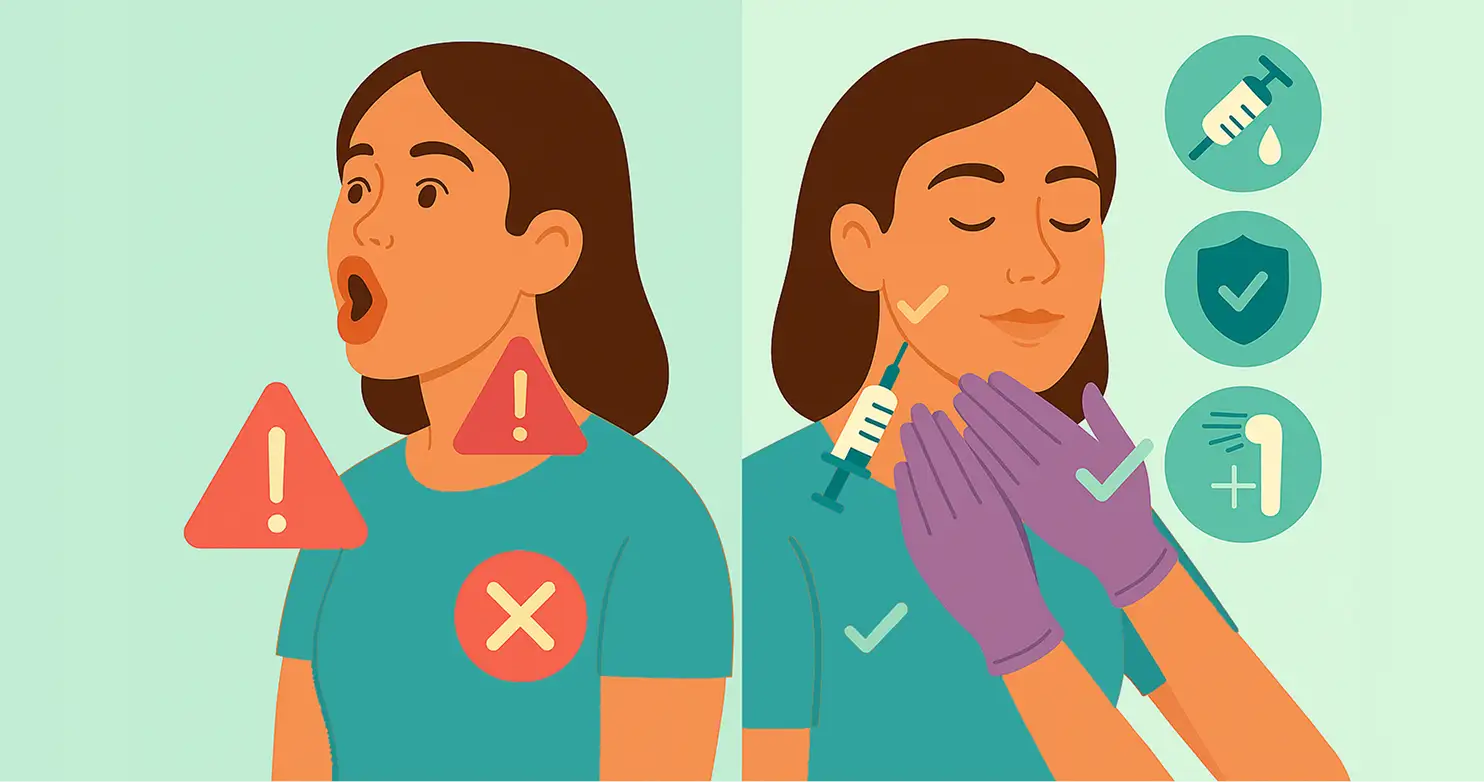
From a clinical perspective, there is no strong evidence showing that facial yoga can deliver lasting results like a true lift or contour. In fact, repetitive exaggerated movements can sometimes have the opposite effect, deepening dynamic wrinkles think laugh lines or crow’s feet or even creating tension in the jaw TMJ issues. For patients with dermal fillers or threads, certain exercises could risk shifting results, which makes them less predictable and less durable.
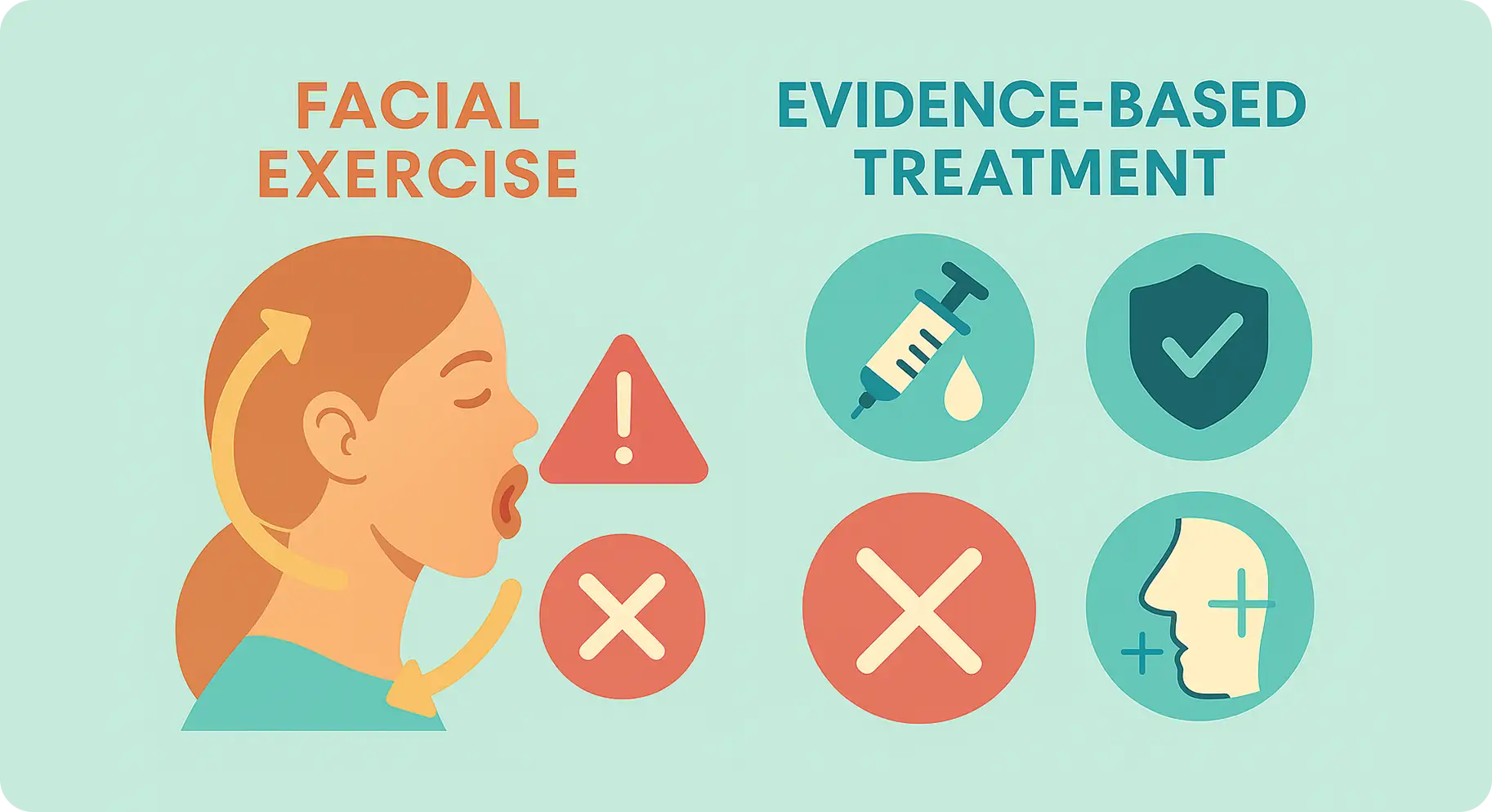
At Perfect B, we do not offer facial yoga as a treatment because it does not match the level of safety and effectiveness we want for our patients. Instead, we guide those curious about it toward proven options, like biostimulators, collagen boosting energy treatments, or tailored facial balancing. These methods address the root causes of sagging and volume loss, not just muscle tone, and results are not only safer but also more consistent. When patients ask about facial exercises, our protocol is to educate them honestly, they may be harmless as a complement, but for real lifting and rejuvenation, evidence based treatments always win.
This expert consensus underscores the importance of choosing treatments backed by robust scientific validation rather than social media popularity.
Targeted concerns and realistic outcomes
Use this section to self triage. Each card maps common goals to what at home work can and cannot do. It also explains when a professional plan makes more sense.
Jowls and lower face contour
Many readers ask specifically about facial exercises for jowls when they begin a self care plan. We explain how facial exercises for jowls can support posture jaw comfort and lymphatic balance while setting realistic expectations about skin laxity.
Readers often ask whether facial exercises for sagging cheeks can restore lift. We position facial exercises for sagging cheeks as a comfort and awareness tool rather than a replacement for tightening. A short routine of facial exercises for sagging cheeks can complement posture work and sleep hygiene. When used with patience facial exercises for sagging cheeks may improve perceived support in the mid face. Keep expectations measured and log facial exercises for sagging cheeks along with hydration and skincare.
What at home may help
Relaxation drills to reduce habitual squinting. Brow and orbicularis re education with a gentle approach. For daily practice keep face exercises smile lines brief and breath guided so the muscles learn to release rather than scrunch.
Likely limits
Repetitive forceful movements can worsen dynamic lines in the upper face. Proceed gently and avoid scrunching. Effective face exercises smile lines favor light touch slower tempo and awareness instead of force.
Clinic path
Neuromodulators for dynamic lines and resurfacing or peels for etched lines. After treatment we sometimes suggest very gentle face exercises smile lines to reinforce relaxed movement patterns.
Safe starter routine, ten to fifteen minutes, four to six times per week
These evidence informed moves mirror the patterns used in clinical studies and consumer guidance. Keep movements gentle, avoid excessive wrinkling, and stop if you feel pain.
- Cheek Lifter Open the mouth into an O, fold the upper lip over the teeth, smile to raise the cheeks, hold one to two seconds, lower, and repeat ten times.
- Happy Cheeks Sculpting Create a pursed lips smile, then glide fingers from mouth corners to cheekbones, hold twenty seconds, and repeat three times.
- Eyebrow Lifter Place fingertips under the brows, gently resist as you attempt to lower the brows, keep the eyes soft, hold twenty seconds, and repeat.
As you practice you are effectively doing facial exercises for cheeks and exploratory cheek muscle exercises. If your goal is how to strengthen cheek muscles, progress by adding a second set rather than squeezing harder. People sometimes ask for a facial exercise for face lift. Be cautious with that request. Surgery addresses tissue repositioning while exercise focuses on neuromuscular control and comfort.
Risks and precautions for patient education
- Dynamic lines risk. Forceful or repetitive contractions in the upper face can etch lines over time. Scale to comfort and control rather than maximum effort.
- Timing with injectables and energy devices. Get your provider clearance before resuming vigorous routines. Start with light relaxation work only.
- Consistency over intensity. The only trial showing measurable changes used a long structured schedule. Quick challenges may change comfort rather than structure.
(…) Professional societies and clinical guidance discuss post filler and post device activity precautions including when to pause massage or vigorous routines. Use these summaries to decide when to restart gentle practice with your provider approval.
When to see a professional, a decision guide you can act on
If your primary goal is sharper contour fewer dynamic lines or predictable timelines at home work will not fully replace in clinic care. Use this quick matrix.
| Concern | Try at home | Professional path | Typical time to notice |
|---|---|---|---|
| Soft jowls | Posture cues and gentle jaw or neck toning, face firming exercises | Energy based tightening and neuromodulators for bands | Weeks to months at home, one to three months in clinic |
| Mid face flatness | Controlled smiles, cheek lifts exercise, facial exercises for lifting cheeks | Biostimulators PRF or fillers | Months at home, immediate to twelve weeks in clinic |
| Smile lines | Relaxation drills and anti wrinkle facial exercises used gently | Neuromodulators and resurfacing | Weeks at home, three to fourteen days for neuromodulators |
| Global laxity | Endurance plus posture and tightening face exercises | RF microneedling or ultrasound tightening | Months at home, three to six months in clinic |
If you are in Doral FL our team can tailor a plan that integrates safe practice with neuromodulators collagen stimulating procedures and skin quality work. The goal is clarity comfort and outcomes.
FAQ: Facial Yoga Myths vs. Medical Facts
Q1 Facial exercises: do they actually lift or just tone?
Facial exercises mostly help with tone, not with a true “lift.” Think of it like going to the gym, your muscles may feel firmer and more active, but that doesn’t mean gravity stops working on your skin. What people often notice is a slight tightening or definition, but it’s not the same as what medical treatments can achieve when it comes to lifting.
Q2 Facial exercises: what evidence is there from a clinical or medical perspective?
From a clinical standpoint, research is pretty limited. A few small studies suggest that certain routines might improve facial fullness or give a healthier appearance. However, there’s no strong medical evidence proving facial yoga can replace aesthetic treatments like fillers, threads, or energy-based skin tightening. In other words, it can be a nice add-on, but not a replacement for clinical methods.
Q3 Facial exercises: what risks (wrinkles, volume loss) should be considered?
Here’s the tricky part: repetitive movements like exaggerated smiling, puckering, or scrunching can actually deepen expression lines over time. Just like how frowning leads to forehead wrinkles, overdoing facial exercises can accelerate those creases. Also, for people with already thin or aging skin, constant pulling and stretching might make laxity or volume loss more visible instead of less.
Q4 Lifted cheekbones: can training create visible contour?
Training can make cheek muscles a bit firmer, which may give the illusion of more . But it won’t truly “lift” the cheekbones themselves. Think of it as a soft glow-up from toning not a sculpting procedure that changes estructuré.
Q5 Does muscle hypertrophy from face exercises for cheekbones create visible lift?
Facial muscles don’t grow the same way biceps do. Yes, some hypertrophy (muscle growth) can occur, but it’s usually subtle. A little plumpness may add shape to the midface, but it won’t create that sharp, lifted cheekbone look most people are aiming for.
Q6 Do facial lifting exercises counter true skin laxity or mainly tone?
They mainly tone. Skin laxity comes from collagen loss, gravity, and reduced elasticity, all things facial exercises can’t fully fix. For real lifting, treatments like biostimulators, energy-based tightening (RF), or threads are far more effective. Exercises may support overall muscle health, but they don’t stop sagging skin.
Trend and context
Lifestyle media and social platforms spotlight the practice for its accessibility and mind body appeal. That can help with motivation. Keep it complementary to evidence based care and use a measured tone when you discuss results with friends or on social channels. Many readers discover facial exercises through trends and then search for facial exercises for jowls, face exercises for cheekbones, face exercises smile lines, and facial exercises for sagging cheeks.