Hair Quality & Restoration Treatment
Solve all questions about Hair Quality & Restoration Treatment Plan. Revitalize volume and health with our comprehensive, non-invasive approach.
Basics & Logistics.
What anesthesia or comfort measures are used during treatment?
At Perfect B, comfort always comes first. Before the PRP injections, we typically apply a topical numbing cream to minimize any discomfort. Some patients describe the sensation as light pressure or tiny pinches rather than pain. The goal is to make the treatment feel as relaxed as possible while maintaining precision.
What is a platelet-rich plasma (PRP) injection?
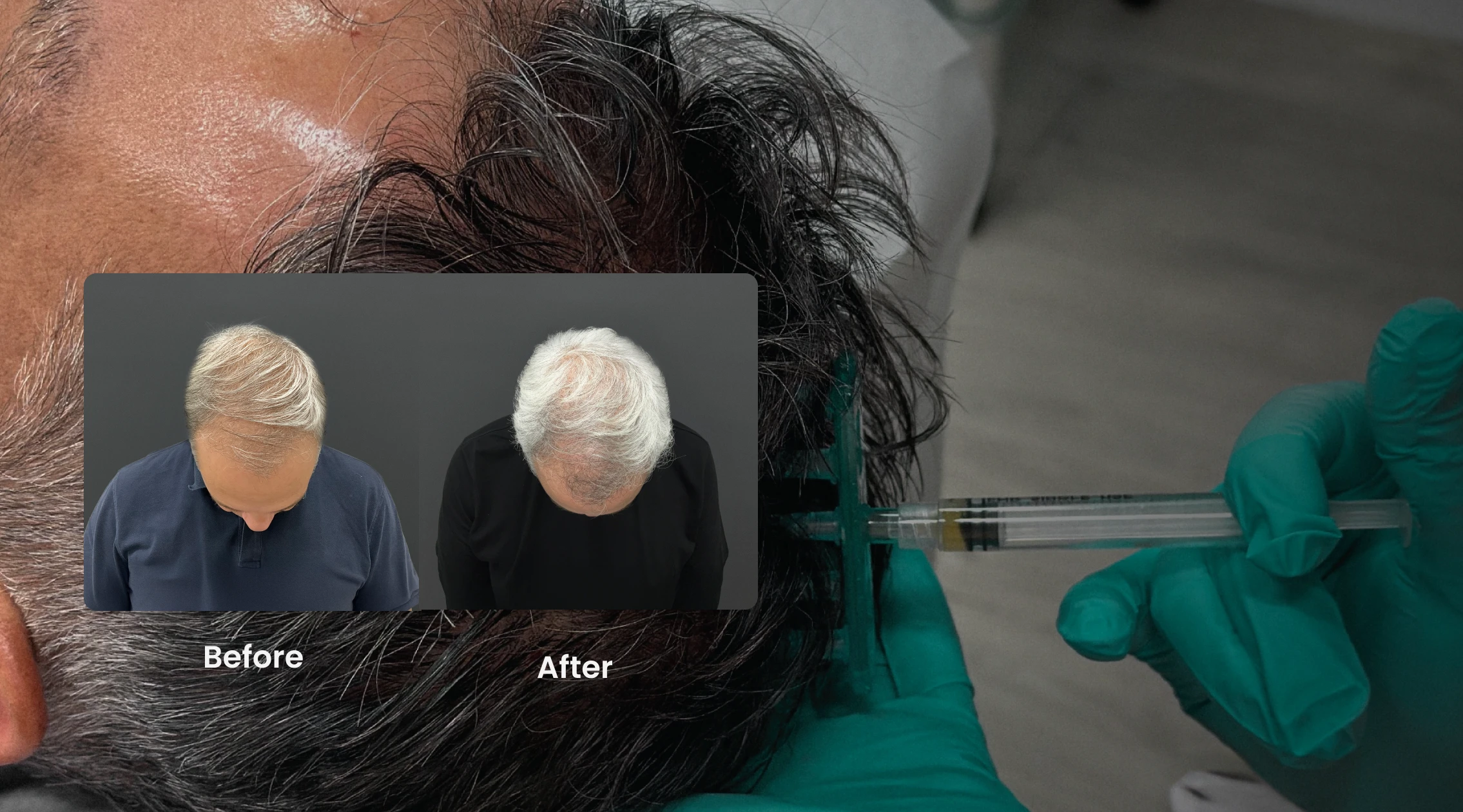
PRP is a regenerative therapy that uses your own blood to help awaken the body’s natural healing process. A small sample of blood is drawn, spun in a centrifuge, and the concentrated layer rich in growth factors is extracted. When injected into the scalp, these growth factors signal your hair follicles to repair, thicken, and grow stronger over time—naturally and without added chemicals.
Areas & Uses.
Can PRP for hair be used to fill a patchy beard safely?
Yes, absolutely. PRP can be used in the beard area just as it is on the scalp. The treatment relies on your own plasma, rich in growth factors that naturally stimulate follicles and encourage new, thicker strands. When applied to the beard, it can help fill in sparse areas without harsh chemicals or implants, simply your body’s own regenerative power.
If I’m choosing between beard oils and PRP, what should I consider first?
Beard oils condition and hydrate the hair and skin, but they don’t activate follicles. PRP, on the other hand, can wake up inactive follicles and improve density from the root. The truth is, they work beautifully together: PRP for stimulation, oil for maintenance and softness.
Can beard oil alone close patchy gaps, or is PRP more likely to do that?
Beard oils help with nourishment, but they can’t create new growth in areas with dormant follicles. PRP, by contrast, has a biological effect on the follicle itself. It promotes regeneration, meaning it’s more likely to help close patchy areas that oils alone can’t fix.
What really helps grow a beard and where does PRP fit in?
Healthy nutrition, good sleep, and gentle care are the foundation. Minoxidil, oils, or supplements can assist, but PRP is one of the few options that directly boosts natural follicle activity without medication. In short, it fits at the top of the beard-growth hierarchy because it works with your biology, not against it.
PRP facial vs. scalp PRP for hair growth: how do goals and techniques differ?
While both use your own plasma, their intentions are quite different. A PRP facial focuses on rejuvenating skin—improving tone, texture, and collagen production—whereas scalp PRP targets dormant or weakened hair follicles to stimulate regrowth. The injection depth, technique, and concentration of growth factors are adjusted accordingly. In essence, the same science works in two unique ways: one to smooth and brighten, the other to strengthen and restore.
Results & Timing.
How does the timeline for results compare between beard oils and PRP?
Oils can give visible softness and shine almost right away, but growth changes are limited. PRP results appear more gradually, typically after 2–3 sessions spaced a few weeks apart, as new hair cycles begin. It’s the difference between styling what you have and truly growing more of it.
How long does a visit take, and what downtime should patients expect?
A full PRP session usually takes about 45 to 60 minutes. Afterward, you can return to most normal activities the same day. Some patients notice mild redness or tenderness at the injection sites for 24–48 hours, but this fades quickly. We simply recommend avoiding vigorous exercise or hair coloring for a couple of days to let your scalp heal undisturbed.
Safety & Side-Effects.
Is PRP hair treatment safe for facial hair areas like the cheeks and jawline?
It is. PRP is a biocompatible, autologous treatment, meaning it’s made from your own blood, so the risk of reactions is minimal. In experienced hands, like at Perfect B, the technique is adjusted for facial skin, which is thinner and more sensitive than the scalp. This ensures safety and comfort during every session.
What mild reactions might happen on the face after PRP?
Mild redness, swelling, or pinpoint bruising are the most common effects, and they usually fade within 24–48 hours. Think of it like a brief post-workout flush, a normal part of your skin’s healing and renewal process. We always provide soothing post-care to calm the skin and support recovery.
What side effects should prompt a follow-up with the clinic?
Mild swelling or sensitivity is normal, but persistent pain, increased redness, or signs of infection like warmth or discharge should be reported immediately. Though rare, these reactions can signal an inflammatory response that needs professional attention. The truth is, when PRP is performed under proper sterile conditions, complications are extremely uncommon. Still, staying in touch with your provider ensures your healing stays on track.
Safety and technology.
PRP clinic standards for hair growth: what credentials, centrifuges, and protocols should patients look for?
Choosing the right clinic truly matters. Look for providers trained in regenerative or aesthetic medicine who use FDA-cleared centrifuges designed for PRP separation. Proper centrifugation ensures your plasma is rich in platelets—where the growth power lies. Clinics should also follow sterile technique, use high-quality tubes without additives, and personalize each treatment based on your scalp assessment. Experience, precision, and technology together make all the difference in your results.
Other content we recomend
Microneedling is one of the most effective skin-remodeling treatments available today, and Miami patients are searching for it at record rates. At Perfect B in Doral, FL, we use the SkinPen by Crown Aesthetics, the first FDA-cleared microneedling device, to treat acne scars, stretch marks, surgical scars, and aging skin. This guide covers what microneedling actually does at the tissue level, which conditions respond best, how it compares to RF microneedling, what a realistic cost looks like, and what to expect from a supervised treatment plan in Miami.
The wolverine peptide is a combination of BPC-157 and TB-500, two tissue-repair peptides that together accelerate healing across soft tissue, tendon, and systemic injury. Named for the Marvel character's regenerative ability, this stack is used in clinical settings in Doral, FL and across South Florida for injury recovery, post-surgical repair, and chronic inflammation.
If you are researching copper peptide for hair loss in Doral, FL, GHK-Cu is the molecule at the center of that conversation. At Perfect B, we use GHK-Cu as part of our peptide therapy protocols for hair restoration and skin regeneration - two areas where the clinical evidence is unusually strong. This review covers how it works, who benefits, and what our protocol looks like.
If you are searching for appetite control & suppressants in Doral FL, understanding how to reduce appetite safely is the first step toward sustainable results. Whether you are comparing the best appetite suppressant pills, evaluating the best appetite suppressant over the counter, or exploring weight loss peptides under medical supervision, a personalized approach matters. In Doral FL, structured medical weight management combines appetite regulation, metabolic evaluation, and ongoing monitoring to help you feel balanced around food while protecting long term health.
If you are looking for a butt facial in Doral FL, Perfect B offers a medical grade approach designed to improve texture, tone, and confidence. Our protocol combines professional cleansing, customized exfoliation, and advanced options like a butt chemical peel when needed, making it more than a basic booty facial. We also guide you with a long term skin care for buttocks plan that fits South Florida’s heat, humidity, and active lifestyle, so results look better and last longer.
Experience the ultimate skin transformation at Perfect B with our medical-grade butt facial in Doral, FL. By combining advanced BBL laser (BroadBand Light) technology with professional exfoliation, we go beyond the standard spa scrub to target "buttne," hyperpigmentation, and rough texture at a cellular level. Our specialized broadband light therapy effectively clears acne-causing bacteria and lifts dark spots, providing a high-performance solution for those seeking a buttocks facial that delivers visible, long-lasting results. Visit our Doral clinic to elevate your body care routine and achieve the smooth, bright, and confident skin you deserve.